

You are using an out of date browser. It may not display this or other websites correctly.
You should upgrade or use an alternative browser.
You should upgrade or use an alternative browser.
Ancient hunter/gatherers were "vegan"
- Thread starter Graeme M
- Start date


Cooking allowed humans to process animal flesh, as we don’t have the necessary physiology to slice’n’dice the raw muscle…unless the flesh was diced with crude stone knives, or smashed up with a rock… I’d say eggs and native honey would’ve been on the menu, though… Even with fire, the diet of many Aboriginal cultures was predominantly vegI think about this topic sometimes and usually end up pondering what our species ate post-cultivation of fire. My thoughts our that we were much closer to vegan diets before cooking was an option.

Lou
Forum Legend
Early man was most likely an opportunistic feeder.
Archeological evidence leans towards a mostly vegetarian eater.
But you can't really hang a vegan diet label on them
Archeological evidence leans towards a mostly vegetarian eater.
But you can't really hang a vegan diet label on them
A lot of people don't realize how varied our diet was before modern agriculture. I watched a show where people went out and gathered edible "weeds" from fields and forests. They then cooked an entire meal out of it.
Some of the "weeds" that I had been ripping out of my garden were actually edible and nutritious. I had been pulling up purslane, and didn't know it was food.

 www.almanac.com
 www.almanac.com
Some of the "weeds" that I had been ripping out of my garden were actually edible and nutritious. I had been pulling up purslane, and didn't know it was food.
Purslane: Health Benefits, How to Cook It, and Why It’s Not Just a Weed
Discover purslane’s health benefits, nutrition, and how to cook this edible weed. Learn why purslane is considered a superfood and how to add it to your meals.
20 Edible Weeds You Can Forage Right From Your Backyard
Discover 20 edible weeds growing in your backyard! Learn how to forage, identify, and enjoy nutritious wild greens like dandelion, chickweed, and purslane.
OP
OP

I think what is of most interest is what humans ate post African exodus. Until about 70,000 years ago, humans mostly lived in Africa and maybe the Middle east, so conditions were relatively consistent. But once we spread around the world, our habitats were many and varied and hence we made many adaptations to different diets. We can't say people ever had any one specific diet. Some ate mostly plants as the recent study in South America showed, some ate mostly animals, such as the Inuit, and others ate some mix of the two. Modern nutty carnivore dieters try to pretend humans were "hyper-carnivores", but that is likely only in certain places and times. Interestingly many hunter-gatherer cultures ate a lot of honey - I think honey was a big part of ancient Hadza diets and was also prized by indigenous Australians.I think about this topic sometimes and usually end up pondering what our species ate post-cultivation of fire. My thoughts our that we were much closer to vegan diets before cooking was an option.
Going back to my original post, the point I was making is that the goals of vegan ethics are quite aligned with the natural state of life, with the extra benefit of our moral agency and compassion. Ancient hunter-gatherers, and nearly all other life, exist in close alignment with vegan goals to the extent their moral agency allows them. Wild animals are free, not treated as chattel property by any other animal, are used/eaten by other animals because that's how things have evolved (thus they have no genuine alternatives) and their cognitive capacities and moral agency are very limited, hence any cruelty they exhibit is unconscious and undirected. Humans really are the outlier. In a very real sense, even lions are more vegan than most modern consumers.... Tell that to the next idiot who posts one of those "Nature doesn't care about vegans" memes!
I even wrote a blog post about that just the other day.
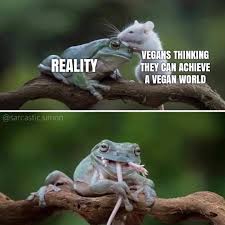
Nature is Vegan, Why Aren’t Humans?
A common meme seen on social media these days shows some wild animal killing/eating another. It invariably comes with a punchline that suggests vegans are avoiding reality. In fact, people posting …
 justustoo.blog
Last edited:

A lot of people don't realize how varied our diet was before modern agriculture. I watched a show where people went out and gathered edible "weeds" from fields and forests. They then cooked an entire meal out of it.
Some of the "weeds" that I had been ripping out of my garden were actually edible and nutritious. I had been pulling up purslane, and didn't know it was food.
I have been watching a lot of yt videos about this topic and also about simple, easy to grow foods that don't need any attention and come back every year - some would call them weeds as they spread easily and are hard to kill off. Even the mesquite tree is an amazing source of food and sunchokes/Jerusalem artichokes have amazing tubers, sumac, tepary beans.. it is a very long list of foods that are all around us and/or easily grown.
Emma JC
Find your vegan soulmate or just a friend. www.spiritualmatchmaking.com
I watched a whole video about the mesquite tree and how it was native in the US south area before "farming" arrived and they cut them all down and so desertification happened because their roots can go down 200 feet or more and they provided shade (along with food). With them gone the soil started to blow away etc. I just went and looked for it to share but can't find that particular one but there are lots available. So fascinating.
Emma JC
Find your vegan soulmate or just a friend. www.spiritualmatchmaking.com
Emma JC
Find your vegan soulmate or just a friend. www.spiritualmatchmaking.com
Lou
Forum Legend
I wasn't going to bring this up because I've written about it before. But I do find it super -interesting.
Way back in our evolution, when we were just getting out of the forest and spreakding thru the savannah, we were finding new niches. We didn't have fire or stone tools yet. But we had a couple of things that we could put to our advantage. We had great vision, we were bipedal and could travel long distances. and we were able to make use of a rock as a tool. And we were able to work in small groups.
Once the sun came up we could spot vultures flying above the kill the large cats made the night before. Then we could walk or trot to that site. Using sticks and stones we could move the scavengers - or just wait for them to leave. And then using rock break into the large bones and suck out the marrow.
We might have been the only animal able to access The marrow in the long bones.
Way back in our evolution, when we were just getting out of the forest and spreakding thru the savannah, we were finding new niches. We didn't have fire or stone tools yet. But we had a couple of things that we could put to our advantage. We had great vision, we were bipedal and could travel long distances. and we were able to make use of a rock as a tool. And we were able to work in small groups.
Once the sun came up we could spot vultures flying above the kill the large cats made the night before. Then we could walk or trot to that site. Using sticks and stones we could move the scavengers - or just wait for them to leave. And then using rock break into the large bones and suck out the marrow.
We might have been the only animal able to access The marrow in the long bones.
That is interesting. Wouldn't the larger animals (cats, wolves etc) along with the vulture types be able to crack the bones? in fact, I think wolves eat the bones too, no? I wonder when our ancestors discovered you can make soup from bones?
Emma JC
Find your vegan soulmate or just a friend. www.spiritualmatchmaking.com
Emma JC
Find your vegan soulmate or just a friend. www.spiritualmatchmaking.com
manakuke
Newcomer
Yeah so truly we began as gatherers/scavengers before fire. That's my guess anyway.Cooking allowed humans to process animal flesh, as we don’t have the necessary physiology to slice’n’dice the raw muscle…unless the flesh was diced with crude stone knives, or smashed up with a rock… I’d say eggs and native honey would’ve been on the menu, though… Even with fire, the diet of many Aboriginal cultures was predominantly veg
I recently gathered about 6 varieties of tasty edible weeds etc from just one area, organic, fresh and last for days and days without refrigeration… unfortunately, our tastes are geared to what we’re taught to like and eat in our particular cultureI have been watching a lot of yt videos about this topic and also about simple, easy to grow foods that don't need any attention and come back every year - some would call them weeds as they spread easily and are hard to kill off. Even the mesquite tree is an amazing source of food and sunchokes/Jerusalem artichokes have amazing tubers, sumac, tepary beans.. it is a very long list of foods that are all around us and/or easily grown.
Emma JC
Find your vegan soulmate or just a friend. www.spiritualmatchmaking.com
Lou
Forum Legend
I don't think the big cats could be bothered. and the kills I'm talking about is large mammals whose long bones were too big for vultures and hyenas.That is interesting. Wouldn't the larger animals (cats, wolves etc) along with the vulture types be able to crack the bones? in fact, I think wolves eat the bones too, no? I wonder when our ancestors discovered you can make soup from bones?
Emma JC
Find your vegan soulmate or just a friend. www.spiritualmatchmaking.com
Google it. some of the research is pretty interesting.

I'm not sure that there were any of "our species" - homo-sapien around before the usage of fire.I think about this topic sometimes and usually end up pondering what our species ate post-cultivation of fire. My thoughts our that we were much closer to vegan diets before cooking was an option.
It's estimated even homo-erectus used fire.

Control of fire by early humans - Wikipedia
"Claims for the earliest definitive evidence of control of fire by a member of Homo range from 1.7 to 2.0 million years ago"
Lou
Forum Legend
I think the point is that the evolution of "our species" is also very much linked to fire.I'm not sure that there were any of "our species" - homo-sapien around before the usage of fire.
manakuke
Newcomer
Ah! Well that narrows things down. I often go back as far as our rodent-like ansestors and beyond when thinking of this kind of thing.I'm not sure that there were any of "our species" - homo-sapien around before the usage of fire.
It's estimated even homo-erectus used fire.
Control of fire by early humans - Wikipedia
en.wikipedia.org
"Claims for the earliest definitive evidence of control of fire by a member of Homo range from 1.7 to 2.0 million years ago"
It's really an interesting topic but has little to do with modern day vegans and the right choice for our future as a species IMHO
manakuke
Newcomer
Yeah thats where my head was. We had a tool that we could create with or destroy and we developed along with that power. The handing down of the torch, the way we build our knowledge of things through teaching, story telling, ect.I think the point is that the evolution of "our species" is also very much linked to fire.
It’s logical that any scavenger with a beak wouldn’t be able to crack large bones, but in another life, my working dogs could grind, crunch up and eat any bones I gave them… With fire and most likely through necessity, humans learnt to break bones, draw out the marrow, or boil bones for soup… No doubt with any veg that was available, nothing was wastedThat is interesting. Wouldn't the larger animals (cats, wolves etc) along with the vulture types be able to crack the bones? in fact, I think wolves eat the bones too, no? I wonder when our ancestors discovered you can make soup from bones?
Emma JC
Find your vegan soulmate or just a friend. www.spiritualmatchmaking.com
Similar threads


- Replies
- 4
- Views
- 495


