Ancient hunter/gatherers were "vegan"

Graeme M

Forum Legend
Joined
Nov 23, 2019
Reaction score
324
Age
66
Location
Canberra, Australia
Lifestyle
  1. Vegan
I've seen quite a few articles in recent years casting the diets of ancient hunter/gatherer populations as anything from vegan to vegetarian to omnivore to hyper-carnivore. Of course, this simply reflects that different groups ate differing diets depending on where they lived. Here in Australia, indigenous peoples in the past ate diets that varied from coast to inland deserts, with some being almost 80% vegetarian and others more like 60-70% animal eaters.

But it seems to me these arguments and claims etc miss the point. Vegans wanting to show that ancients ate mostly plants are up against it because people have always eaten animals to some extent or another. What if we think about it a different way?

The aim of veganism is fairness - that we should be fair to other animals when we can do that. The goals are really just two: for all animals to be free, and for us not to be cruel to them whenever we can do that.

Sooo... the ancients lived before agriculture and domesticated animals even existed. Thus, all animals were free. The animals they hunted and ate, were free. The main goal of veganism was realised. Of course, the ancients were likely cruel to the animals. Spearing them, trapping them, driving them over cliffs is essentially cruel in effect. But, let's be honest, they had few alternatives, likely sought to despatch animal prey as quickly as possible in the circumstances, and likely tended not to simply kill as many animals as they could at any given time. Their cruelty hardly exceeded that of other predators and likely was rather less so.

It seems to me that all our ancient hunter/gather ancestors lived lives that were - in practice - consistent with the goals of veganism. And at the least, much more so than modern folk. We don't have to prove what they did or did not eat.
 
I too, find this an interesting topic of discussion. And I also agree that most of the discussions misses the point but maybe for a different reason that you do.

For me veganism is an intention. and the intention has to do with compassion - compassion for animals.

I also think that there is a difference between a plant based diet and the vegan lifestyle. It might be just in the details but again I feel it mostly has to do with intention.

Several early societies did not eat meat. And although I'm sure that they felt compassion for animals that was not their stated primary reason. Many of these cultures believed in reincarnation. You didn't eat kill animals (or even bugs) because that animal may have been your uncle Eddie. or you might come back as a lamb.
 
  • Like
Reactions: Graeme M
For me veganism is an intention. and the intention has to do with compassion - compassion for animals.
Yes, that's true. That's why I didn't say ancient peoples actually were vegan. My point is that their lifestyles was actually consistent with veganism, far more so than most modern people's lifestyle. Veganism wants animals to be free and us not to be cruel, whenever that's possible. That's exactly how things were to the extent it was possible for the people who lived then. Of course they didn't specifically intend to be vegan, but I think they did intend to have perhaps a fairer regard for the other animals we often don't have now. I think that in many cases, other animals ("nature") was woven into their mythologies and cultural beliefs, in such a way that they had a deeper respect for the lives of other animals than we seem to encourage.

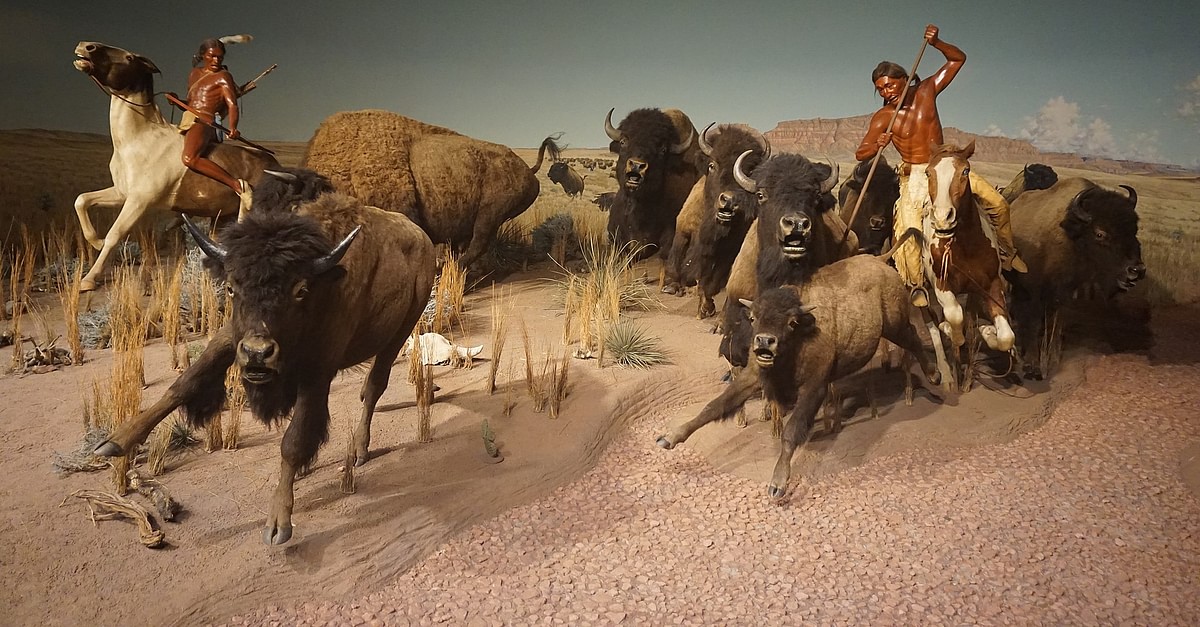
In this article about the Plains Indians of North America, the author highlights how the buffalo was an intrinsic part of both diet and culture with the people revering the animal as a gift from the Creator.

While the diet of these people was high in animal content derived from bison, deer, elk, antelope and others, they also ate what plant foods were available such as hazel nuts, wild plums, prickly pear, wild onion etc. They ate judiciously from their surrounds, used all of the animals they killed for food and other resources and treated both the animals and the environment as vitally important and inherent to their spiritual outlook.

We could say that in this way, the Plains Indians - and many other ancient hunter/gatherer societies - were fundamentally fair in their relationship with other species. And it's fairness that we are aiming for with veganism. Compassion might be the driver, however it's not mere kindness we are wanting but an actual state - that of fairness and justice for other species. So I'd argue - with good reason, I hope - that ancient hunter/gatherers lived far more consistently with the aims of veganism than we do today. That's why there is no reason to spend any time whatsoever trying to prove what diet ancient people ate (because they never ate just plants).

 
  • Like
Reactions: Lou
It's all about the options you have and the choices you make. If you have the option of buying plant based food in your supermarket but instead buy flesh or go out and hunt animals for food, you are not a vegan. If you had plenty of hazel nuts, wild plums, prickly pear, wild onion etc, in the wild but still chose to hunt animals for their flesh then you are not a vegan. If the above wild plant based foods were less in quantity then you have no option than to hunt for animals, which would be ethically vegan. It's all about the options you have and the choices you make. I bet that these hunter folks wouldn't have give up their animal hunting even if there was plenty of wild plant based food available, so I would not consider them vegan.

A best candidate for historical vegans would be jains. Back in the day, in BCE, jains were vegan. Of course they drank milk, but the cows were treated extremely well to the point of worship(compared to the factory farming cows of today whose milk these current day non-vegan jains drink). They didn't kill the male calves but used them(after they grew up) as transport and for tilling the soil . Of course they had no option, but to have milk because there was no B12 supplements back then, or cars and tractors. So you could say there were vegans way way back. But they were not primitive hunter gatherer folks but from advanced agricultural civilizations. Ofcourse their intent might be different, as it's less to do with empathy and more to do with reincarnation, but the historical jains would still be considered vegan, as some vegans of today are still by definition vegans not because of empathy for animals but because of health and other selfish reasons.
 
Last edited by a moderator:
  • Like
Reactions: Earthchild and Lou
I bet that these hunter folks wouldn't have give up their animal hunting even if there was plenty of wild plant based food available, so I would not consider them vegan
OK, but I didn't say that ancient hunter/gatherers were vegan. I said that in their lifestyles - what they actually did - they were far more consistent with the goals of veganism than most folk today. We don't need to prove what they ate - that's irrelevant to what we do today. But we can point out the fact they were more like vegans than most moderns.

I believe there are just two goals of veganism - for animals to be free to live their own lives and for us not to be cruel to them, whenever we can do that. So, to what extent were those goals achieved 20,000 years ago, compared to today? Just to be clear, I'm not saying that hunter/gatherers were all making fair and kind choices, not by any stretch of the imagination. They just lived their lives. But the end result was much more like what veganism is about than how most of us are living today, when we look at things from the point of view of other animals.
 
Last edited:
  • Like
Reactions: Earthchild and Lou
OK, but I didn't say that ancient hunter/gatherers were vegan. I said that in their lifestyles - what they actually did - they were far more consistent with the goals of veganism than most folk today. We don't need to prove what they ate - that's irrelevant to what we do today. But we can point out the fact they were more like vegans than most moderns.

I believe there are just two goals of veganism - for animals to be free to live their own lives and for us not to be cruel to them, whenever we can do that. So, to what extent were those goals achieved 20,000 years ago, compared to today? Just to be clear, I'm not saying that hunter/gatherers were all making fair and kind choices, not by any stretch of the imagination. They just lived their lives. But the end result was much more like what veganism is about than how most of us are living today, when we look at things from the point of view of other animals.
Is their hunting lifestyle more ethical than the lifestyle of current day hunters, other omnivores and vegetarians? Yes, they killed the animals, but didn't torture them in factory farms atleast. They disrupted the ecosystem yes, but they didn't have the choice/learn about agriculture.

Is their hunting lifestyle more ethical than the lifestyle of vegans of today? I'd say no because these hunters would have still intentionally killed animals when plant based options could have been available. Current day vegans make the choice of leaving out animal products when plant based options are available. So current day vegans are morally superior to those old age hunter gatherers.

--

Imagine if the entire world became vegan, we could return back atleast 30 million sq km back to forests. That's a 75% increase of forest area. And if we leave this increased forest area alone(don't hunt) we could finally stop the holocene mass extinction.

Now imagine if the entire world population of 7.5 billion(leaving out 0.5 billion due to vegetarians/vegans) embraced the hunter gatherers lifestyle of hunting in the forests, imagine what would happen. This is the current animal stock situation in the world as of now.


Cattle 416 Million Tonnes
Buffalo 68 Mt
Sheep 39 Mt
Pigs 38 Mt
Goats 32 Mt
Chickens 73Mt (I calculated approximately)
Camels 9Mt
Didn't include turkeys and other birds.

total 684 million tonnes.


Wild land mammals - 24 Mt
Let's add another generous 70 Mt of wild reptiles and wild birds left in. the wild.

That's just 94 million of wild animal mass in total.

So these 7.5 billion people letting go of 684 million tonnes of grazing and factory farmed animals, and embracing a hunting lifestyle to just get 94 million tonnes of wild animals. How long do you think these poor wild animals would last? They would completely empty the forests of wild animals max within 3 years of hunting.
 
  • Like
Reactions: Earthchild and Lou
So these 7.5 billion people letting go of 684 million tonnes of grazing and factory farmed animals, and embracing a hunting lifestyle to just get 94 million tonnes of wild animals. How long do you think these poor wild animals would last? They would completely empty the forests of wild animals max within 3 years of hunting.
Well, yes that's true. I don't think that I suggested we should all go back to being hunter/gatherers, though. I'm just pointing out an interesting fact about veganism - that in practice, ancient folk were living pretty much according to the ethics. Of course, they neither knew about that nor would they have cared and it's irrelevant to what we do now. BUT, the point is there's no need to worry about what they ate. Veganism isn't a diet, it's an ethics aimed at keeping animals free and not caused to unnecessarily suffer from our actions. I just think that's a more fruitful line of argument than trying to pretend people used be mainly eating plants.
 
It's all about the options you have and the choices you make. If you have the option of buying plant based food in your supermarket but instead buy flesh or go out and hunt animals for food, you are not a vegan. If you had plenty of hazel nuts, wild plums, prickly pear, wild onion etc, in the wild but still chose to hunt animals for their flesh then you are not a vegan. If the above wild plant based foods were less in quantity then you have no option than to hunt for animals, which would be ethically vegan. It's all about the options you have and the choices you make. I bet that these hunter folks wouldn't have give up their animal hunting even if there was plenty of wild plant based food available, so I would not consider them vegan.

A best candidate for historical vegans would be jains. Back in the day, in BCE, jains were vegan. Of course they drank milk, but the cows were treated extremely well to the point of worship(compared to the factory farming cows of today whose milk these current day non-vegan jains drink). They didn't kill the male calves but used them(after they grew up) as transport and for tilling the soil . Of course they had no option, but to have milk because there was no B12 supplements back then, or cars and tractors. So you could say there were vegans way way back. But they were not primitive hunter gatherer folks but from advanced agricultural civilizations. Ofcourse their intent might be different, as it's less to do with empathy and more to do with reincarnation, but the historical jains would still be considered vegan, as some vegans of today are still by definition vegans not because of empathy for animals but because of health and other selfish reasons.


I'd like to make a small correction. Cows do not synthesize B12. Modern cows receive B12 from injections.

Our ancestors got their B12 from the soil. They didn't have our overly hygienic method of eating. No peeling, no intense washing, and if a little bit of dirt got into the pot, it was OK. The B12 remained in the food FROM THE PLANTS.


The vitamin is synthesized by soil microbes that form symbiotic relationships with plant roots.
 
I'd like to make a small correction. Cows do not synthesize B12. Modern cows receive B12 from injections.
I'm not sure that's quite true. Cows DO produce B12 in their gut though technically it's their gut bacteria that do that. They need cobalt from their diet and then use rumen microbes to synthesise cobalamin. It's true that there are bacteria in soil that synthesise B12 but cows don't rely on those, they already have the bacteria in their guts. What they need is cobalt in their diet. They can still have B12 deficiency in certain conditions, so they need to be supplemented. I don't think that's a standard, whole of life thing though. I am pretty sure our ancestors primarily got their B12 from animal tissue. Other great apes get a lot from eating their own poop, because like us, their bacteria that synthesise cobalamin live too far down the digestive tract to produce absorbable B12.
 
I'm not sure that's quite true. Cows DO produce B12 in their gut though technically it's their gut bacteria that do that. They need cobalt from their diet and then use rumen microbes to synthesise cobalamin. It's true that there are bacteria in soil that synthesise B12 but cows don't rely on those, they already have the bacteria in their guts. What they need is cobalt in their diet. They can still have B12 deficiency in certain conditions, so they need to be supplemented. I don't think that's a standard, whole of life thing though. I am pretty sure our ancestors primarily got their B12 from animal tissue. Other great apes get a lot from eating their own poop, because like us, their bacteria that synthesise cobalamin live too far down the digestive tract to produce absorbable B12.
And vegetables would grow in soil naturally fertilized with poop. Water would contain B12 from the soil runoff.
 
  • Like
Reactions: 1956
Veganism isn't a diet, it's an ethics aimed at keeping animals free and not caused to unnecessarily suffer from our actions. I just think that's a more fruitful line of argument than trying to pretend people used be mainly eating plants.
Graeme M.: Veganism IS a diet. What veganism is "aimed at" depends on the individual. Each person's exact motivation may be different though we overlap each other. I think the most "defensible" reason to eat a vegan diet, if you need to defend it, is that eating lower on the food chain reduces the carbon footprint of each person, so it decreases global warming. So reason (1) Fight Global Warming.

Defensible reason (2) End cruelty to animals.
We torture animals from birth until they die an early, cruel death.

It's a bonus that we are healthier if we do not eat animals and animals products, but certainly that has to be defensible reason
(3) Plants are healthier to eat than animal derived foods

I do not see "keeping animals free" as a major underlying reason to eat a vegan diet. Most animals that are eaten are not free, but domesticated meat-animals would not be set free if everyone immediately ate vegan. Where would all the "freed" domestic animals go? In fact, the lifestyle of humans now is reducing numbers of some wild life. Why would there be herds of beef cattle or herds of dairy cows in world with all vegans. Animals that depend on human's feeding them would cease to exist, not be set free.

Eating animals that DO live free is not defensible in any way, as far as I am concerned. I do not consider it defensible to kill deer to eat, to fish for a meal, to eat oysters and clams.
 
  • Like
Reactions: 1956
Veganism IS a diet. What veganism is "aimed at" depends on the individual. Each person's exact motivation may be different though we overlap each other. I think the most "defensible" reason to eat a vegan diet, if you need to defend it, is that eating lower on the food chain reduces the carbon footprint of each person, so it decreases global warming. So reason (1) Fight Global Warming.
I don't agree with you there. Eating a plant-based diet to mitigate climate change is simply a climate change mitigation strategy. Sure, you can call it a "vegan" diet if you want, but that is not veganism.

Defensible reason (2) End cruelty to animals.
We torture animals from birth until they die an early, cruel death.
That is one aspect of veganism, to be sure. But it's not the complete ethics. Veganism is an ethics the aim of which is to deliver fairness and justice to other animals, where by "fairness and justice" we mean much the same as for people - for animals to be free, to have bodily autonomy, not to be used unfairly and not to be treated cruelly, to the extent that's possible. The goal of veganism is to end cruelty to animals to the extent we can achieve that.

(3) Plants are healthier to eat than animal derived foods
I don't agree with this either. It is possible to eat a wholly plant-based diet and be healthy but I don't think that means that animal derived foods are inherently unhealthy.

I do not see "keeping animals free" as a major underlying reason to eat a vegan diet. Most animals that are eaten are not free, but domesticated meat-animals would not be set free if everyone immediately ate vegan. Where would all the "freed" domestic animals go? In fact, the lifestyle of humans now is reducing numbers of some wild life. Why would there be herds of beef cattle or herds of dairy cows in world with all vegans. Animals that depend on human's feeding them would cease to exist, not be set free.
I feel you are missing the point somewhat. The aim of veganism is for animals to be free WHEN they exist. If animals are owned and used for exploitative purposes, such as horses in commercial horse racing or trained animals in circuses or farmed animals, then clearly they aren't free. So long as those industries exist, those animals will never be free. Withdrawing economic support - which is what vegans do - will not cause the animals to be freed but rather for fewer to be created by those industries. If those industries disappeared, then no more animals would exist in those industries. The animals left in the world would be free. We should remember that by and large in the case of exploitative animal-using industries, the aim of veganism is not to "save" animals, but to prevent them existing in the first place.

Eating animals that DO live free is not defensible in any way, as far as I am concerned. I do not consider it defensible to kill deer to eat, to fish for a meal, to eat oysters and clams.
It is not defensible when alternatives exist. When there are no alternatives, it is perfectly permissible within vegan ethics to eat animals. Are you suggesting that vegan ethical principles demand that we starve to death rather than eat an animal?

Taking all of this together, it is clear that in ancient times, the wild animals in the world were all free. The humans that existed had few alternatives and eating animals as part of their diet was necessary. They simply did not have the knowledge, nor the reason, to adopt a hands off approach to their relations with other animals. Were they cruel? I don't know, but to the extent possible within the context of the times, I suspect they were not as a matter of course. Perhaps there were groups/cultures in which torturing animals was seen as a valid contribution to food production but again they did not necessarily know better.

I suggest that ancient hunter/gatherers lived consistently with the aims of veganism to the extent that was possible or practicable for their time and context.
 
  • Disagree
Reactions: 1956
To be honest, despite the definition of veganisms according to the UK Vegan Society, it is for me unclear what the goal of veganism is in reality.

Surprising is that most vegans are against cooperation with vegetarians. But even if the mainstream would eat a steak less per week it would have a tremendeous effect on food production. But stll, vegans mostly apply the "all or nothing"-doctrin. So saving animal lifes or reducing animal consumption cannot be the goal of veganism.-

From my point of view veganism aims more on the personal conscience than helping animals.
 
To be honest, despite the definition of veganisms according to the UK Vegan Society, it is for me unclear what the goal of veganism is in reality.

Surprising is that most vegans are against cooperation with vegetarians. But even if the mainstream would eat a steak less per week it would have a tremendeous effect on food production. But stll, vegans mostly apply the "all or nothing"-doctrin. So saving animal lifes or reducing animal consumption cannot be the goal of veganism.-

From my point of view veganism aims more on the personal conscience than helping animals.
While veganism is an ethical stance, and we'd all like to see an end to all exploitation, that doesn't mean they all agree on a means to that end.
There certainly are a ton of militant vegans who won't accept any variation. Even a post on a vegan recipe site from someone admiring they aren't vegan, but likes many plant based dishes gets vitriol. Suggesting cutting back on meats isn't ever enough to many

I take a far more practical view and respect those who make efforts to try and eat more plant based--for any reason
People eat animal products because that's what's the norm. My biggest wins come from suggesting other ways to make foods, not calling people murderers 😳 🤣. Even just getting people to realize soup does not need meat broth, or that how much our lives have changed to be more conducive to eating veg'n, as opposed to our ancestors.
 
I'm a little softer on the Reductionists. The realization that it isn't natural or healthy to eat over a pound of animal products per day has taken a while. Many people can stop eating animal products all at once, but, for many, it is a gradual experience.

The Meatless Monday gradually adds Meatless Friday. The morning cereal with milk becomes cereal with soymilk. The morning breakfast sandwich with meat, egg, and cheese, becomes a PB& J. It can take a while for people to learn the process of replacement of animal products.

I applaud every time someone reduces their consumption of animal products. If we could even reduce the world's consumption by 50%, it would be a big win.
 
To be honest, despite the definition of veganisms according to the UK Vegan Society, it is for me unclear what the goal of veganism is in reality.
Ending , where possible, the exploitation of animals. Surely that's obvious.
Surprising is that most vegans are against cooperation with vegetarians.
Simply not true. Many, if not most vegans either came via vegetarianism.
Now, if someone says "I am vegetarian for the animals" and then are given the facts about the sheer inhumanity of the dairy and egg industry and simply shrug it off... Then that's another thing.
But even if the mainstream would eat a steak less per week it would have a tremendeous effect on food production. But stll, vegans mostly apply the "all or nothing"-doctrin. So saving animal lifes or reducing animal consumption cannot be the goal of veganism.-
There are definitely many vegans who are too "all or nothing" and I agree that it's counter-productive to the movement as a whole.
But. I see these as the "noisy minority".
The number of people who I consider "pretty much vegan" is far higher than the number those more extreme individuals would admit to.
From my point of view veganism aims more on the personal conscience than helping animals.
It's definitely personal conscience. But as I mention above, I think the majority of vegans do want what's ultimately going to save most animals.

I've always personally tried to, where applicable, take the utilitarian view.
eg. Cultured meat. From the beginning it won't be truly vegan, as it requires animal tissue. But it will save a huge number of animals from slaughter if it takes off.
So, I (and I suspect most vegans) am all for it.

Then there are the issues regarding testing... esp Impossible foods.
Many claim they are not vegan as they underwent animal testing to expedite the swift expansion of their products because of some outdated food regulations. There will be no more animal testing, so for me, they are vegan. Many vegans disagree.

Bi-valves. Not vegan by definition, but I have no issue with their consumption, and in fact they could be a really great farmed food source, with little to zero by-catch or unwanted deaths. Far less than growing most crops.

Honey. I don't eat it myself, but I find it hilarious that it is such an issue when just as many bees are used for industrial crops that are considered vegan.
 
  • Like
  • Friendly
Reactions: 1956 and Lou
I've seen quite a few articles in recent years casting the diets of ancient hunter/gatherer populations as anything from vegan to vegetarian to omnivore to hyper-carnivore. Of course, this simply reflects that different groups ate differing diets depending on where they lived. Here in Australia, indigenous peoples in the past ate diets that varied from coast to inland deserts, with some being almost 80% vegetarian and others more like 60-70% animal eaters.

But it seems to me these arguments and claims etc miss the point. Vegans wanting to show that ancients ate mostly plants are up against it because people have always eaten animals to some extent or another. What if we think about it a different way?

The aim of veganism is fairness - that we should be fair to other animals when we can do that. The goals are really just two: for all animals to be free, and for us not to be cruel to them whenever we can do that.

Sooo... the ancients lived before agriculture and domesticated animals even existed. Thus, all animals were free. The animals they hunted and ate, were free. The main goal of veganism was realised. Of course, the ancients were likely cruel to the animals. Spearing them, trapping them, driving them over cliffs is essentially cruel in effect. But, let's be honest, they had few alternatives, likely sought to despatch animal prey as quickly as possible in the circumstances, and likely tended not to simply kill as many animals as they could at any given time. Their cruelty hardly exceeded that of other predators and likely was rather less so.

It seems to me that all our ancient hunter/gather ancestors lived lives that were - in practice - consistent with the goals of veganism. And at the least, much more so than modern folk. We don't have to prove what they did or did not eat.
I’m an Aboriginal Wiradjuri man from NSW Australia and I appreciate your post… It was survival, and according to what we know, a greater proportion of our natural diet was vegan, depending on location… Despite what the western dominant culture say and portray, our relationship with country and all life, is symbolic. We took what we ‘needed’ to survive sustainably, with thanks and great respect… Now, in most countries, there’s no need to eat ‘other’ animals, as there’s an abundance of rich, wholesome food…
 
I’m an Aboriginal Wiradjuri man from NSW Australia and I appreciate your post… It was survival, and according to what we know, a greater proportion of our natural diet was vegan, depending on location… Despite what the western dominant culture say and portray, our relationship with country and all life, is symbolic. We took what we ‘needed’ to survive sustainably, with thanks and great respect… Now, in most countries, there’s no need to eat ‘other’ animals, as there’s an abundance of rich, wholesome food…
Yes, the typical diet in pre-colonial Australia varied with place as you say. I've read it could be up to 80% plants. But more importantly, those people largely took only what they needed (because they had to) and were rather more respectful of the natural world than we are today. The animals remained free and I think there was no institutionalised cruelty to them.
 
  • Agree
  • Like
Reactions: Lou and jalan
Yes, the typical diet in pre-colonial Australia varied with place as you say. I've read it could be up to 80% plants. But more importantly, those people largely took only what they needed (because they had to) and were rather more respectful of the natural world than we are today. The animals remained free and I think there was no institutionalised cruelty to them.
Thx for the affirmation. And while there may have been isolated instances of mistreatment, our culture was a symbiotic one (which is what I meant to say, rather than ‘symbolic’; although, symbolism is a part of all cultures).
 
  • Like
Reactions: Graeme M