
The UK is Europe's most obese nation:
http://www.theargus.co.uk/news/national/news/10778550.Fizzy_drink_tax__would_cut_obesity_/
http://www.theargus.co.uk/news/national/news/10778550.Fizzy_drink_tax__would_cut_obesity_/


"As sugar sweetened drinks are weak appetite suppressants, a reduction in their consumption is likely to lead to a reduction in calorie intake,
...with people being unlikely to seek alternative sources of calories"

Having given this a further 5 seconds thought ...
(As a vending business owner I have reason to be particularly interested in this, btw)
Q. If the intent is to reduce sugar consumption then why not legislate a maximum sugar % in food products instead of raising tax on them?
A. That would actualy reduce the consumption of already massively tax rich high sugar content food products leading to lower tax revenues.
Figures on tax revenue for high sugar filth are quite staggering ..
I buy confectionary bars and cans of pop for around 35P and sell them in my machines at 70P.
Of that 70P, 14P goes straight to the vatman leaving me 19P gross profit.
From that 19P I have to fund capital equipment, maintenance thereof, storage, admin, wastage, wages, vehicles, admin, accountancy, marketing and all other associated expenses of running a business.
If that leaves any profit from my 19p I lose 4p of that to HMRC in corporation taxes (CT).
CT and VAT combined total at 18p nett profit to my 19p gross profit, basicaly.
On top of that; Out of the original 35p CT & VAT have already been taken at the same percentages from everyone else in the chain - raw materials, proccessors, manufacturer, warehousing & distribution, wholesaler, etc.
Loosely I calculate that for every £1.00 profit anyone retailing high sugar products can make that tax revenue is a minimum of a tenner.
Effectively that makes the taxman a 90% shareholder in every business selling high sugar products. A very special shareholder at that. One who contributes nothing, has all his work done for him and makes a guaranteed 45%+ dividend irrelevant of if the business actualy makes any profit.
Value of UK vending market (excluding other methods of high sugar food retailing) in 2005 estimated at £3,424,000,000.
That's £684,800,000 in VAT alone!
Point simply being that high sugar filth peddling is a massive gravy train for the Government.
They b'aint never gonna pass any legislation that would derail that little baby, not even in the slightest.

CG - have you ever considered selling healthy products in your vending machines ?
That was the plan when I started the business 10 years ago, Shyvas.
A lot of people asked for healthy stuff in the vending machines but, once it was there, actual uptake was abysmal.
About an 80% wastage (product out of date before sold) factor - totally unsustainable.
It's not that healthier eating is not on the increase, I don't think, though ..
More that interest in healthier food tends to lead to people buying and carrying more of their own stuff with them.
That leaves the machine to cater almost exclusively for the 'don't cares' and for the occasional 'naughty' treat.
Naughty treats and stuff the 'don't cares' like to snack on are thus all that sells at viable levels in vending machines.
Strangely, I actualy feel happy when I see my takings going down.
I used to like vending machines as a kid. After a swim, watch the packet of Quavers dropping from the swirly wire thing..treat! We didn't have crisps that often as a kid, so it was always a treat.
The hospital I work across from has healthy vending machines along with the regular junk food ones.
That is interesting. Prehaps you could try and find the right places ( business, airports, stations, waiting rooms etc) to place the Healthy vending machines ?
Do you think that people are becoming healthier or have less money if they aren't using the V machines ?
Those are the places I have my machines, Shyvas.
I also have machines in staff only areas of my local hospital where you might expect to see health consciousness high on the agenda.
Same rules apply across the board ...
Healthy stuff crawls and high sugar/salt/fat stuff flies.
.
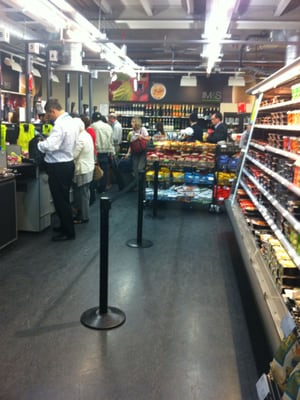
but M&S and Sainsburys probably have a bigger catchment area than a lot of vending machines.

There are probably more vending machines than M&S simply foods or Sainsbug's in one single town. However I have noticed a distinct trend of people picking up 'healthier' snacks.

If I have fully understood the vending machines mainly sell junk food ? That is strange because these last few years, shops like M&S Simply Food and Sainsburys food on the go sell a large choice of healthy snacks.
There are always large queues with people picking up snacks. I also make a point of doing so when I arrive in the UK.
It's not that healthier eating is not on the increase, I don't think, though ..
More that interest in healthier food tends to lead to people buying and carrying more of their own stuff with them.
If I have fully understood the vending machines mainly sell junk food ? That is strange ...
Hi shyvas
We have an unusually health "aware" staff cafe in the building where I work. Vegan and veggie alternative hot meals fresh fruit snack bowls, and an abundance of grain bars and healthy snacks on the counter for those grabbing a snack...
But the owner was asked in person and by letter if she would also offer chocolate bars, normal snacks and crisps as an alternative.She has done this and they are selling as well if not better than the grain bars and fruit!
Yes, I see the same thing ...
The 'strangeness' of that is easily explained ..
The largest of food/snack/cold drink vending machines can only offer 40 different products at any given time.
They are very small 'shops'. (Correct name for vending is 'Automatic Retailing', btw).
Part of the 'problem' works like this:
Say healthier eaters account for 10% of those with access to any given vending machine ..
So you allocate 10% of the machine space to healthier products ..
That allows 4 selections of healthier product.
4 selections is not enough choice so you will acheive far less than the 10% potential sales.
If you provide a wider choice, say 10 products, you then have 25 % of your 'shelf space' tied up with products that will only account for 10% of your sales.
The math changes with volume though ..
If you have enough potential customers to justify 10 'small shops' then one of those shops could be dedicated entirely to the healthier eating crew.
At the volumes necessary for that you are in full bore catering territory which relegates vending machines back to picking up the scraps.
Then your right back to square one again.


