Hitler in 1923

rainforests1

Forum Legend
Joined
Jul 11, 2012
Reaction score
101
In 1923 Hitler had attempted a putsch. It failed. They could have had him executed or given him a very long jail sentance. Being weak on criminals can cause problems, and this is an example. What would you have done to Hitler in 1923?
 
I agree. It's great to have 20/20 hindsight, but nobody in the world (and even Hitler himself) knew how history would eventually play out once Hitler got out of prison and got to work with his evil plans. The Nazi movement began and gained strength in the 1920's, but I don't think most people in Germany or elsewhere took them seriously until they were able to get into real positions of power. So I think the answer is to not to simply throw everyone in jail or execute them on the offchance that they'd eventually murder millions or people, but to keep a check on political power. It's possible that had the US not had a strong isolationist movement all throughout the 1930's and into the 1940's (up until Pearl Harbor was attacked 7 December 1941, and then the country's isolationism vanished), we could have gone to Europe a lot sooner than we did to stop the Nazis.
 
  • Like
Reactions: yally
I don't see anything unfair about it. He attempted to overthrow the government and got something like 9 months in prison. Similar circumstances applies in the United States today. People receive a slap on the wrist for rape, and go back into society and rape again. Hitler would be an extreme example but there are many examples of a society being weak on criminals and other people suffering from that later on. If you allow a person back into society after doing a major crime you know there's a chance bad may come out of it. You have no excuse for it.
 
So I think the answer is to not to simply throw everyone in jail or execute them on the offchance that they'd eventually murder millions or people, but to keep a check on political power.
People who I feel should be given long jail sentances:murder, animal cruelty, drunk driving, rape, or attempting a putsch(drug users would not be arrested). It's just your major criminals that would be targeted. I'd hardly consider that "everyone". I'm neutral on the death penalty so I'm not advocating that.
 
Why have I never had the word putsch before? I looked it up.

And after the loss of men in WWI, I sure would have been an isolationist, too, had I lived then. My grandfather sobbed for the only time in my grandmother's memory when his three sons enlisted in the second ww, for he had been a marine in the first world war.
 
  • Like
Reactions: rainforests1
Erm, do you know anything about interwar Germany? It was highly unstable, a coup attempt was bound to happen, it just happened to be Hitler. It's not likely a weak government would have the resources to punish anyone in the manner you're suggesting.

Also, it seems like you are advocating punishing people for thought crimes, which is a very dangerous step.
 
  • Like
Reactions: FortyTwo and Amy SF
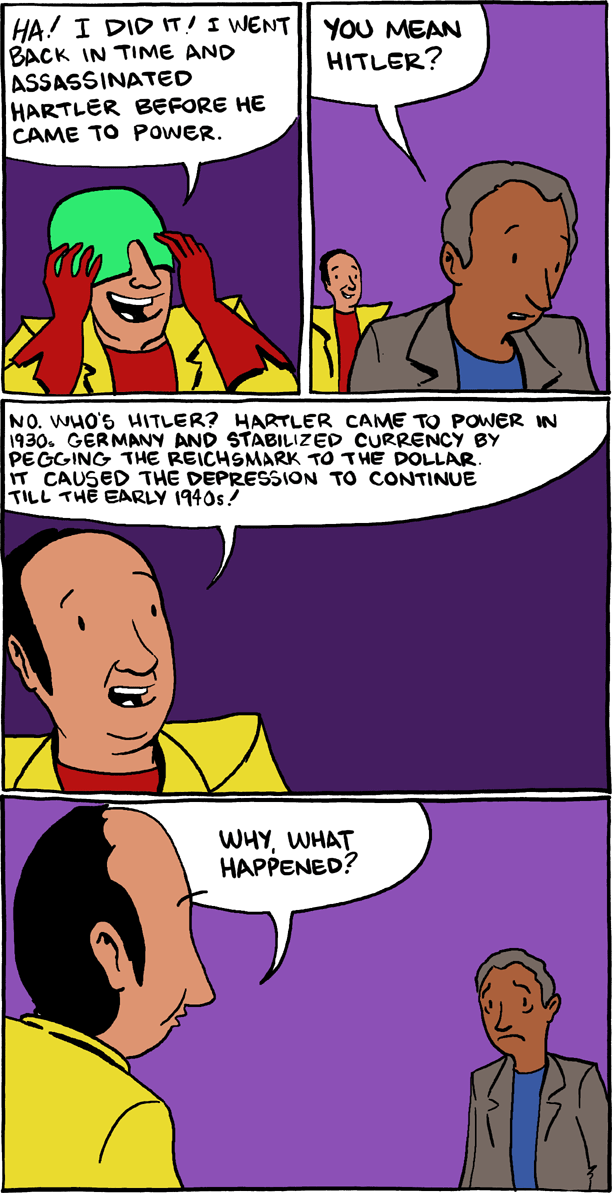
20130319.gif
 
  • Like
Reactions: FortyTwo
The problem with this is that psychology is an incredibly imprecise science. There is no way to tell if one offense, minor or major, will be a person's last. And due to the fact that there are so ridiculously many ways a person can go, I don't think we'll ever reach a level of psychology where we can accurately predict how someone is going to act.
 
  • Like
Reactions: yally and Amy SF
Erm, do you know anything about interwar Germany? It was highly unstable, a coup attempt was bound to happen, it just happened to be Hitler. It's not likely a weak government would have the resources to punish anyone in the manner you're suggesting.

Also, it seems like you are advocating punishing people for thought crimes, which is a very dangerous step.
Even a jail sentance of ten years(minor given the crime) could have prevented World War 2. Why are you assuming this was not possible? The history books won't mention it, but it's a fact that Germany being weak on criminals may have caused World War 2. Blame for that war can go to many different people. Attempting a putsch is not a thought crime, so I have no idea what you're referring to with the last sentance.
 
Why have I never had the word putsch before? I looked it up.

And after the loss of men in WWI, I sure would have been an isolationist, too, had I lived then. My grandfather sobbed for the only time in my grandmother's memory when his three sons enlisted in the second ww, for he had been a marine in the first world war.
You also have to consider the millions of people that died from the influenza outbreak after troops returned from the war. An isolationist policy made a lot of sense.
 
"Even a jail sentence of ten years could have prevented WWII". Yeah, see, that's just it. The Germans, unfortunately, could not read crystal balls, and therefore had no idea that WWII were coming.

A little history lesson (you're lucky - one of my classes this semester spent quite a bit of time on interwar Germany - I'm a veritable fount of knowledge :p): After the First World War, the Weimar Republic replaced the Imperial government. Weimar was a democracy, was very new (est. 1919) and followed both war and an internal revolution. Several - and I mean several, there were so many different political parties I kind of glazed over during this part of the lecture - were vying for power.

Given these facts, and the fact that Hitler's coup attempt was largely nonviolent (he had SS men with guns but they weren't used, and he was dumb - after his takeover he let Karr go), it's not surprising that Hitler didn't get a larger jail sentence. Hitler was still a leader of a political party - he still had the support of a chunk of the population (not a very large chunk - but no party had a very large chunk). It's likely that the leadership viewed his actions as somebody who's still naive and new to politics, and would calm down with time. And what were they gonna do? Arrest every party leader and every revolutionary who agitated against the party in power? The government was still very new, and still trying to find it's footing. So no, I don't think there was reason or motivation to lock Hitler up for longer than he was.

What I mean by "thoughtcrime" is that you want to lock people up because they have the ability to commit future acts. We can't lock 1920 Hitler up for the actions of 1933 Hitler. And we can't lock a petty burglar up today based on the fact that they may commit a more heinous crime tomorrow. We have to take each crime individually, otherwise it wouldn't truly be a justice system.

As an aside, I think Hitler always comes up as an example because he's so easy to hate. Our gut reaction is, if I could go back in time, yes, I'd lock him up and throw away the key. The Third Reich was a heinous crime against humanity. Which, IMO, makes these kinds of questions unfair. We can't answer objectively because of course we want Hitler to die, and any attempt to be objective makes us (or me at least) feel gross because we're defending what is easily one of the worst people who has ever lived.

 
  • Like
Reactions: FortyTwo and Amy SF
My belief is the government should have the right to protect itself. He wrote his book while in prison and it was released shortly afterwards. They should have read his book(you assume they did), and, at the very least, given him more prison time. After reading his book they'd know he was a threat. That's the problem with World War 2:you could see it coming very easily. So many "ifs" involved. Many people got very rich off of that war, so I'm sure they were very happy to see it happen.
 
They, they, they. Who is *they*? You have to be very specific when referring to interwar Germany, for all the reasons mentioned above. Quite frankly, it was a bit of a clusterfuck. Who should have read his book? The government? Which part? You see how it isn't as clearcut as all that?

And *we* can easily see how the events leading up to WWII contributed to war; but surely you can see how people living during that time might not have seen things so clearly?
 
They, they, they. Who is *they*? You have to be very specific when referring to interwar Germany, for all the reasons mentioned above. Quite frankly, it was a bit of a cluster****. Who should have read his book? The government? Which part? You see how it isn't as clearcut as all that?

And *we* can easily see how the events leading up to WWII contributed to war; but surely you can see how people living during that time might not have seen things so clearly?
Hitler mentions wanting to move eastward in his book. That means war. Whomever was in charge of his prison sentance could have confiscated his material while he was in prison. I see nothing wrong with that. If he shows good behavior while in prison and his writings show nothing unusual, he should be released. If not, he should be kept in there much longer. You'd judge him partially on the putsch, and partially on his words.